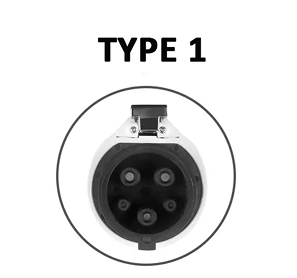
The Type 1 (J1772 / SAE J1772) charging standard is found on older and Japanese-specification electric vehicles — principally the Nissan Leaf, Mitsubishi Outlander PHEV, and Nissan e-NV200. If your EV arrived with a Type 1 cable, a dedicated Type 1 wall charger is the right solution for your home. Our EWRB-registered electricians fit Type 1 chargers throughout Christchurch to the same exacting standard, compliance, and fixed pricing as every other job we do.
Type 1 chargers are not a lesser option — for the vehicles designed around them, a dedicated Level 2 Type 1 unit delivers 3–5× faster charging than a standard 10A outlet on a purpose-built, safe, code-compliant circuit. Many Christchurch Leaf owners have already made the switch. The return on investment in convenience and safety is hard to argue with.
The standard connector for Nissan Leaf, Mitsubishi Outlander PHEV and similar vehicles

Type 1 — also called J1772 or SAE J1772 — is a single-phase AC charging connector developed in North America and subsequently adopted by Japanese EV manufacturers for their domestic and export models. The connector has a characteristic 5-pin D-shaped profile with an integrated latch.
Depending on the model, Type 1 vehicles accept AC charging at up to 3.3kW, 6.6kW, or 7.4kW. While this ceiling is lower than the three-phase capacity of some Type 2 vehicles, it remains substantially quicker than a standard 10A household socket delivering 2.3kW.
Nissan Leaf owners charging from a standard outlet typically face a 10–20-hour wait for a full battery, varying with battery size. Moving to a dedicated Type 1 Level 2 charger cuts that to 3–6 hours for the same result — on a circuit that is properly rated, compliant, and built for sustained overnight use.
Identifying your connector: A Type 1 charging port has a roughly oval or D-shaped profile with 5 openings — a large circular hole at the top, two smaller circular holes beneath it, and two flat proximity detection pins at the bottom. If that matches your vehicle's inlet, a Type 1 charger is what you need.
The following are the Type 1 vehicles we fit chargers for most often across Christchurch. The Nissan Leaf alone accounts for a significant share of the city's entire EV fleet.
New Zealand's original everyday EV — and still among the most numerous EVs on Christchurch streets. Every Leaf generation from 2011 through to 2022 uses a Type 1 inlet. A 6.6kW Type 1 charger tops up the 24kWh first-generation battery in roughly three hours; the 62kWh third-generation takes around nine hours.
The top-selling plug-in hybrid in New Zealand. The Outlander PHEV's 20kWh battery draws through a Type 1 connector, and a 3.3kW Level 2 charger replenishes it in around 5.5 hours — a meaningful improvement over the 8-plus hours required via a standard 10A socket.
Also includes the Nissan e-NV200 cargo van, Mitsubishi Eclipse Cross PHEV, Toyota Prius Prime, and various early Chevrolet Volt imports. If you're uncertain whether your vehicle uses a Type 1 connector, check the inlet profile or give us a call — we can identify it immediately.
A surprising number of Nissan Leaf and Mitsubishi PHEV owners around Christchurch have been plugging into a standard 10A outlet for years. The car charges — eventually — but the method is both slow and carries risks that are easy to overlook.
A standard 10A socket pushes 2.3kW. For a Nissan Leaf 40 with its 40kWh pack, a full charge from empty takes 17 hours. That means daily plugging-in just to keep pace with normal use. More pressing is the safety issue — standard outlets were never designed to sustain the high current draw of EV charging for 8–12 hours at a stretch. In older Christchurch homes with ageing wiring, this repeated load can generate heat at the outlet itself, creating a real fire risk that we have encountered directly on the job.
A dedicated Type 1 Level 2 circuit runs correctly-sized wiring from the switchboard, incorporates a purpose-built 32A breaker, and terminates in a weatherproof wall unit engineered for continuous EV charging duty. The result is faster charging, a safer installation, and a Certificate of Compliance that protects you legally.


Mark and Pam had been driving their 2019 Nissan Leaf 40 for close to two years, charging entirely through the standard 10A socket in their Riccarton garage. Filling the 40kWh battery from flat required 17 hours — so they often went to sleep with only a partial charge and occasionally woke to find the overnight window had not been enough. On Christchurch's cold winter evenings, running the heat pump and the Leaf through the same garage circuit would sometimes trip the breaker, leaving the car flat by morning. The couple were also uneasy about the safety of running high current through their ageing 10A outlet night after night — a concern that deepened when they noticed the outlet face growing warm during extended sessions. A chat with a neighbour who had recently had a dedicated charger fitted was the nudge they needed.
We inspected the 1998 switchboard and established that it had sufficient available capacity for a new dedicated 32A circuit without any panel modifications. A new circuit was run from the switchboard through the house wall cavity to the garage, where we wall-mounted a tethered Type 1 Level 2 charging unit. The dedicated circuit isolates the Leaf's charging load entirely from the existing garage outlets, putting an end to the shared-circuit fault that had been tripping the breaker on cold winter nights. The Leaf's onboard charger handles up to 6.6kW AC, so the new unit operates at its full rated output from the moment the cable is connected. We checked that all cabling, terminations, and the new breaker were rated for continuous overnight draw — squarely addressing the safety concern about sustained nightly use through ageing wiring. Everything was done in a single visit and the Certificate of Compliance was issued that afternoon.
Mark and Pam's Nissan Leaf 40 now charges to full in approximately six hours — less than a third of the time it previously took via the standard outlet. The dedicated circuit has completely resolved the breaker-tripping issue that had been a recurring winter headache. The Leaf is plugged in each evening on arrival home and sits fully charged well before midnight, regardless of which other appliances are running. Monthly home charging costs come to around $25–30 at their overnight electricity rate. Mark says the most tangible change is that neither of them checks the state of charge before leaving in the morning anymore — the car is simply always full. The CoC addressed their long-held concern about the safety of sustained nightly charging, which had been on their minds since they first noticed heat at the outlet. The Leaf has not left the driveway short of charge once since the installation was completed.
"We wish we had done this the moment we drove the Leaf home. The change is night and day — we never give range a second thought because the car is always charged. The job was clean, the electrician arrived on time, and the whole thing was completely straightforward." — Pam A., Riccarton, Christchurch
A 6.6kW Type 1 Level 2 charger delivers three times the power of a standard 2.3kW outlet. A Leaf 40 that previously took 17 hours is fully charged in 6 hours. Every morning the battery is ready to go.
A dedicated 32A circuit with RCD protection eliminates overheating risk at the outlet. The wiring and breaker are correctly sized for continuous overnight EV charging — particularly important in older Christchurch homes with ageing electrical infrastructure.
A CoC accompanies every Type 1 installation we complete — mandated under the NZ Electricity Act 1992. You need it for your home insurance policy and for property disclosure when you eventually sell.
Type 1 installations are among our most competitively priced jobs. A written fixed-price quote is confirmed before any work starts — everything covered, no additions on the day.
We serve residential customers across Christchurch City, Banks Peninsula, and North Canterbury. Find your suburb using the alphabet below.