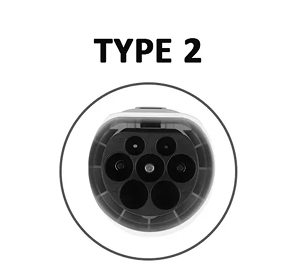
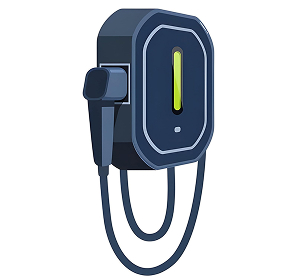
The Type 2 (IEC 62196) connector is the established AC charging standard for every current-generation electric vehicle available in New Zealand. Driving a Tesla, BYD, Hyundai, Kia, MG, BMW, Audi, Volkswagen, Volvo, or another contemporary EV means a Type 2 wall charger is exactly what you need at home. Our EWRB-registered electricians carry out Type 2 charger installations throughout Christchurch with transparent fixed pricing and a Certificate of Compliance on every completed job.
Choose 7kW single-phase — by far the most common residential fit — or 11kW three-phase if your property has a three-phase supply. Either way, you gain substantially faster replenishment than a standard 10A socket, and our DLB solutions mean most Christchurch households can avoid a switchboard upgrade entirely.
7.4kW single-phase / 11kW three-phase

Type 2 is the default AC charging connector fitted to every new electric vehicle sold in NZ today. Whether your car arrived from a European, Chinese, or Korean manufacturer, it almost certainly charges via Type 2. Below are the models we install for most frequently across Christchurch:
How to check: Inspect the charging port on your vehicle. A Type 2 inlet is roughly circular with a flat upper edge and 7 contact pins. If your car shipped with a cable that connects to a household socket at one end, you typically need a dedicated Type 2 wall charger rather than a tethered unit. Ring us if you're uncertain — we can confirm your connector type in moments.
Most Christchurch homeowners we work with opt for a Type 2 charger paired with Dynamic Load Balancing — and there's a practical reason why it's become our most-requested combination.
A large share of Christchurch homes — particularly those built before 2010 — operate switchboards already under meaningful demand from heat pumps, hot water cylinders, and other high-draw appliances. Connecting a 7kW EV charger via a dedicated 32A circuit can take some boards to their limit. Without DLB, that gap typically gets bridged with a switchboard upgrade costing $1,500–$2,800.
DLB removes that requirement. A CT clamp sensor is fitted at the switchboard and communicates current usage data to the charger in real time. Every few seconds, the charger recalculates available capacity and adjusts its draw accordingly — pulling full power when the house is calm, dialling back automatically when the oven or heat pump kicks in. Your EV always charges at the maximum safe rate for that moment, without putting any strain on your panel.
We supply and install all the leading Type 2 charger brands available in NZ. Here's a no-jargon guide to which unit suits which situation:
Our highest-volume Type 2 installation. Sleek, compact, and fully DLB-capable, the Pulsar Plus links to the Wallbox app for remote scheduling, usage tracking, and access management. Eco-Smart mode provides entry-level solar diversion support. Suited to: Most current-generation EVs, households wanting app connectivity, DLB setups. Fully installed from $1,650.
The first choice for solar households. Zappi operates in three modes: Fast (draws from the grid), Eco (blends grid and solar), and Eco+ (solar surplus only). DLB-ready via CT clamp. No other charger on the market offers the same depth of solar control. Suited to: Solar PV owners, energy-conscious drivers. From $1,850 installed.
Designed and manufactured in New Zealand for NZ grid conditions. Ocular connects with major NZ electricity retailer platforms and features integrated load management. Backed by local technical support and a strong warranty. Suited to: Buyers who prefer NZ-made products and want responsive local backup. From $1,750 installed.
Tesla's dedicated home charging unit — the natural fit for Tesla drivers. Pairs natively with the Tesla app, delivers up to 11kW on three-phase supplies, and uses the standard Type 2 connector, making it equally usable with non-Tesla vehicles. Suited to: Tesla Model 3, Y, S, X, and Cybertruck owners. From $1,750 installed.
Our Type 2 installation rates are among the most competitive in Christchurch — and every job is completed to the same standard of quality, safety, and regulatory compliance.
Pricing applies to cable runs up to 10m at a standard residential property. Extended runs, any required switchboard modifications, or unusual cable routing are itemised separately and confirmed in your fixed-price quote.
David and Michelle collected their BYD Atto 3 in February and quickly discovered the realities of relying on public charging. The closest DC fast charger in Christchurch was a 12-minute drive away, and at peak evening hours they were typically queuing 15–20 minutes for a bay before charging even started. Monthly spend on public charging reached roughly $170, and the time overhead was a constant irritant. Their Halswell home, though only six years old, had a switchboard already servicing two heat pumps, an electric hot water cylinder, and a ducted ventilation system — all sharing a single-phase 63A supply. Adding a Type 2 charger on a standard 32A dedicated circuit created a genuine overloading risk during the evening window when they typically arrived home, plugged in the car, and started preparing dinner at the same time.
A DLB charger was clearly the right answer — and the financially sound one, sidestepping any panel work entirely. We fitted a Wallbox Pulsar Plus 7.4kW with a CT current transformer clamp on the mains feed at the switchboard. The CT clamp streams live current readings to the Wallbox, which responds by trimming the Atto 3's charge rate — anywhere from the full 7.4kW down to a minimum of 1.4kW — whenever household demand climbs. During the busy evening cooking and heating period, the charger steps back on its own. Once the family settles for the night and appliance demand drops, it ramps back up and the Atto 3 finishes quickly. The whole installation was completed in a single day. We then set up the Wallbox app to schedule overnight charging from 11pm to 6am, locking in the cheapest available electricity rate.
David and Michelle's BYD Atto 3 now wakes up fully charged every morning regardless of appliance use the night before — the DLB system has operated invisibly and without fault since the first day. Home charging costs around $40 per month on their overnight tariff, compared to $170 previously at public stations, producing a net monthly saving of $130. The Wallbox app gives both of them daily visibility into session duration, cost per charge, and total CO₂ avoided — Michelle checks it habitually and finds the running savings data a genuine motivator. The Certificate of Compliance was issued on installation day. The DLB approach eliminated the need for a switchboard upgrade that would have added approximately $2,100 to the project cost. Over the ten months since installation, the Atto 3 has used a public DC fast charger exactly twice — on long-haul weekend drives. Every other charge happens at home.
"When it was explained to us beforehand, the DLB system seemed like it might be complicated to live with. In practice, we notice nothing — the car charges and that's it. The app is easy to read, the scheduling does exactly what we asked, and we haven't thought about a public charger in months." — David T., Halswell, Christchurch
We carry out residential Type 2 charger installations across Christchurch City, Banks Peninsula, and North Canterbury. Use the alphabet below to locate your suburb.